



Imagine joining an anime community and finding three profiles: Sora, ✦Sora, and ꧁✦𝕾𝖔𝖗𝖆✦꧂. All three try to convey personality, but they offer different experiences to anyone who needs to mention the name in a comment, invite the person to a clan, or search for them after a discussion about the episode of the week.
A username isn't just a decoration. In spaces like Anime Profile, where there are feeds, comments, clans, and reader participation, it acts as a signature that accompanies conversations and friendships. A small detail can be memorable; a sequence that's hard to type can make identification more work. The useful question isn't “which username is the most elaborate?”, but “which one remains mine when someone tries to find me?”
Start with a personal reference, not ten symbols
Before choosing a frame, think about what you would like to convey. Do you like mystery anime? Do you prefer a soft identity, inspired by flowers and moons? Are you the person in the group who always arrives with theories, fan arts, or manga recommendations? These traits can suggest a name that feels more unique to you than copying the moniker of a famous character.
A simple formula combines a memorable core word with a subtle visual element. For example: Sora → ✦Sora; Neko → 『Neko』; Akari → ☾Akari. These are fictional style suggestions, not real users or a guarantee of availability on platforms.
Those who enjoy exploring fancy fonts can experiment with how their name looks in their bio or display name field, while keeping an easy-to-type version so they can be found and tagged. Depending on the platform, the login handle or @username may follow stricter rules than the display name: check the actual options for the field before changing the identity your group already knows.
Three username styles — and when each one works
Style 1: Clean
Fictional example: Sora
Best use: Frequent conversations, mentions, and clans
Keep in mind: Might need a complement to stand out
Style 2: Accentuated
Fictional example: ✦Sora
Best use: Display name and bio
Keep in mind: Check if the symbol displays properly on your friends' phones
Style 3: Ornamented
Fictional example: 『✦Sora✦』
Best use: Decorative titles, headers, and profile art
Keep in mind: Less practical to copy, dictate, and quickly recognize
A name with subtle accents usually balances creativity and readability. On the other hand, a large frame might make sense in intro art, without needing to accompany every message from your profile. There is room for both versions, as long as each serves a purpose.
Japanese characters: pretty, but not meaningless decorations
Anime and manga spark curiosity about Japanese writing, which combines hiragana, katakana, and kanji, among other systems. They aren't three “fonts” to swap freely: they are writing systems with distinct functions. The Unicode standard documents hiragana and katakana characters and their properties. After all, a visually appealing expression could actually be a real word — or end up meaning something very different from what you imagined.
Here are a few examples that can serve as references when their meaning is fitting:
Writing: ねこ
Reading or common meaning: neko, “cat”
Note: Word written in hiragana
Writing: さくら
Reading or common meaning: sakura, “cherry blossom”
Note: Word written in hiragana
Writing: ツ
Reading or common meaning: tsu, a syllable in katakana
Note: Also used as a visual smiley outside of Japanese writing
Writing: 星
Reading or common meaning: “star”
Note: Kanji with different readings depending on the word
Writing: 月
Reading or common meaning: “moon” or “month”
Note: The meaning and reading depend on context
Avoid combining random characters and claiming the sequence “means courage” or “is my character's name” without checking a linguistic source. It's also worth distinguishing cultural inspiration from impersonation: using a word whose meaning you know is different from presenting yourself as a Japanese speaker or an official franchise representative.
Clans and groups: a tag that your group can easily repeat
A clan can adopt a short prefix to make its members recognizable. Instead of everyone using a completely different border, try a simple convention: ✦ for the group followed by the username; or a text tag like |NEKO| Sora and |NEKO| Akari. These are made-up examples to illustrate the idea, without claiming that any given platform allows brackets, spaces, or symbols in its fields.
If you're organizing a group, agree on three things beforehand: official tag, readable name, and rules for changes. That way, someone who changes their picture or bio style remains recognizable. On Anime Profile, community features like the feed and clans make this consistency much more useful than competing over who uses the longest ornamentation.
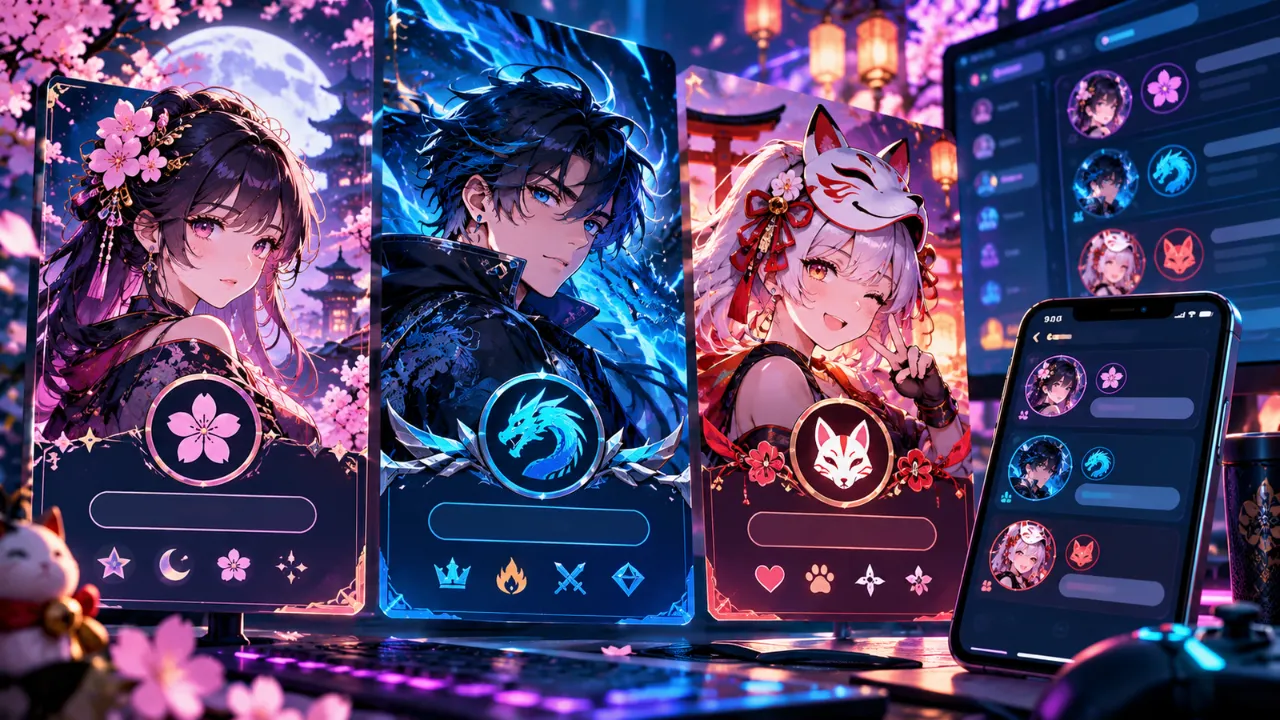
The difference between symbols, stylized letters, and emojis
Not all decorations work the same way. ★ is a text symbol; 🌙 is an emoji that can have a colorful graphical representation; and letters like 𝕾 belong to specific Unicode character sets, not a font installed on the recipient's device. The appearance depends on the font, app, and system.
In practice, you can look for symbols to copy and select a star, a moon, or a short frame; then paste the combination into a test chat or profile preview first. The goal of comparing is to check how it looks on screen, not to assume a specific symbol works universally.
If a symbol turns into an empty square on a friend's device, swap it for a more common one. If the name is only recognizable when displayed in large artwork, dial back the decorations before using it in a member list or comments.
The four-scenario test before saving
You don't need a paid tool to quickly review your username. Consider four real-world scenarios that happen in online communities:
Comments: is the main word still clear on a single short line alongside replies and emojis?
Search or mention: can someone type, copy, or explain your name without having to guess symbols?
Different screen: how does it look on a different phone, with a different font and theme?
Group invite: does the tag identify the clan without making each member's name disappear?
A good approach is to keep a simple version of your name and save the more elaborate visual style for your bio, header image, or an introduction post. This also makes it easier to notify friends when you want to change your handle without losing touch with those who already know your profile.
Personality shouldn't lead to confusing you with someone else
It's normal to find two fans who like the same character, use the same color, or pick the same star symbol. The issue arises when a name or avatar is put together to look like an official account, a moderator, or another well-known member. The Unicode Technical Standard #39 describes visually confusable characters, including those from different alphabets. Just because two names look identical doesn't prove they belong to the same account.
Before replying to an unexpected message or sharing personal information, double-check the profile URL and the indicators provided by the platform itself. And when creating yours, avoid symbols that mimic official verification. A hand-drawn badge in a username doesn't grant authority or replace a real profile.
A username that fits you lasts longer than a trend
The coolest part of an otaku profile isn't turning every letter into a special effect: it's matching your look with how you engage. People who recommend stories, draw fan art, discuss theories, or welcome newcomers end up building an identity through their interactions. A recognizable name helps tie all those small contributions together.
Pick your reference, test the readability, confirm the meaning of any characters, and only then finish decorating. The result can be subtle, dark, funny, or energetic — as long as people can still call you by your name.
About the author
Sophie Ale is a content writer at Letras Diferentes, where she researches and writes about Unicode, digital typography, decorative characters, online identity, and digital communication. You can also check out her author profile.
