


There is a genre that finds its strength in simplicity: the Slice of Life. If you are looking for a break from the action and prefer stories that reflect real life, with its small dramas and great joys, you need to know what Slice of Life is. This genre is a “slice of life” that invites us to slow down and appreciate the beauty of the most mundane moments.
Origin and Meaning of the Term

The term Slice of Life is an English expression that literally means “slice of life”. In the context of art and entertainment, it describes a narrative technique that presents an arbitrary sample of a character's life, often without a central plot or a traditional dramatic climax.
In anime and manga, Slice of Life has established itself as a genre that focuses on everyday events, social interactions, and subtle character development. It moves away from major conflicts and focuses on routine, whether it be school, work, or family-related.
Characteristics of the Genre

Slice of Life has characteristics that make it unique and attractive for those seeking a more relaxing and contemplative experience.
Focus on Everyday Life
The main characteristic is the emphasis on routine. The stories take place in familiar environments, such as schools, cafes, residential neighborhoods, or workplaces. The events are generally mundane: studying for exams, shopping, participating in school clubs, or simply talking with friends.
Subtle Character Development
Unlike Shonen, where growth is marked by new powers and victories in battle, in Slice of Life the development is internal and subtle. The focus is on emotional changes, the formation of bonds of friendship, and overcoming small personal obstacles.
Absence of Central Conflict
Many Slice of Life anime do not have a “villain” or a grand ultimate goal. The pleasure of the work lies in the journey and the observation of interactions. When there is conflict, it is generally interpersonal or emotional in nature, such as difficulty making friends or overcoming a loss.
What is Slice of Life and why is it so relaxing?

The appeal of Slice of Life lies in its power of relaxing escapism. By presenting us with an idealized reality, where problems are manageable and friendship is constant, the genre offers emotional comfort.
It allows the viewer to feel part of a welcoming group, creating a sense of nostalgia and well-being. The slow pace and the absence of major adrenaline peaks make it the perfect genre for decompressing after a stressful day.
Examples of Famous Anime
Slice of Life is a diverse genre, often mixed with comedy, romance, or fantasy.
K-On! (2009)

A classic example of Cute Girls Doing Cute Things (CGDCT). It follows a group of girls who form a light music club, focusing more on their interactions and fun than on the musical performance itself.
Yuru Camp (Laid-Back Camp) (2018)

An anime that celebrates the beauty of nature and the joy of camping. It is known for its extremely calm atmosphere and for sparking the desire to travel and explore.
March Comes In Like a Lion (3-gatsu no Lion) (2016)
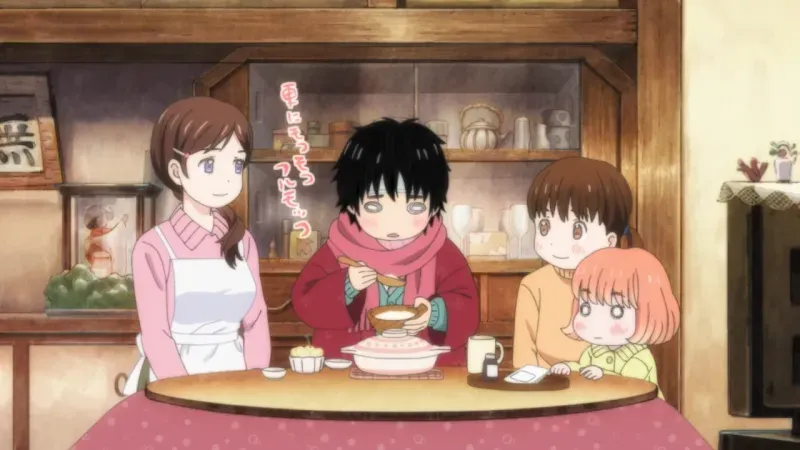
A more dramatic and psychological work, following a young professional Shogi player. Although it has a competitive theme, the main focus is on overcoming loneliness and building a found family.
Nichijou (My Ordinary Life) (2011)

An absurd comedy that mixes daily life with surreal events. It shows that even the most “ordinary” life can be full of hilarious and unexpected moments.
Cultural Impact and Variations

Slice of Life is a flexible genre that easily combines with others, creating popular subgenres:
Iyashikei: The “healing genre,” which focuses on evoking feelings of peace and tranquility in the viewer (e.g., Mushishi).
Gakuen-mono: Focused on school life, the most common setting for Slice of Life.
The genre is a necessary counterpoint to high-intensity anime, proving that stories about the “here and now” can be just as engaging as those involving saving the world.
In short…

The Slice of Life is a celebration of life in its simplest and purest form. It reminds us that happiness often resides in the small moments and human connections. By inviting us to observe the daily lives of its characters, the genre offers a welcoming refuge and a fresh perspective on the beauty of our own “slice of life.”
